

etting your hands on a 3D printer opens the door to a universe of possibilities. Be it something functional like a doorknob or recreational like tabletop gaming minis – there’s one common element tying it all together: 3D printer filament. If you don’t know your PLA from your ABS, or if you’re not sure if you need nylon or polypropylene, you’ve come to the right place.
Below, we offer an easy-to-digest overview (with all the essential and useful data) of all of the common 3D printer filament types you may encounter. From the fun stuff like color-changing PLA to the tough stuff like carbon-fiber-reinforced polypropylene, we show you what to use and how to use it.
Whether you’re printing cosplay armor in PLA, impact-resistant parts in ABS, or flexible components in TPU, this guide will help you pick the right material—and get the best possible results. Keep an eye out for links in nearly every category to our in-depth guides on how to print with these materials and the top brands we recommend. Filament is big business. More than a billion dollars worth of filament is expected to be sold in 2025, and not all of it is worth your cash.
Let’s dive into the full spectrum of 3D printing filaments and uncover which are right for your next project.
There are six polymers most used in 3D printing: PLA, ABS, PETG, TPU, nylon, and PC. You may never need more than these and while figures vary, it’s estimated that 50% of the filament market is PLA, which comes is a wide range of properties and types. In this first category, we introduce you to the six most commonly used 3D printer filaments, all popular for their specific physical properties.
PLA
What is PLA?
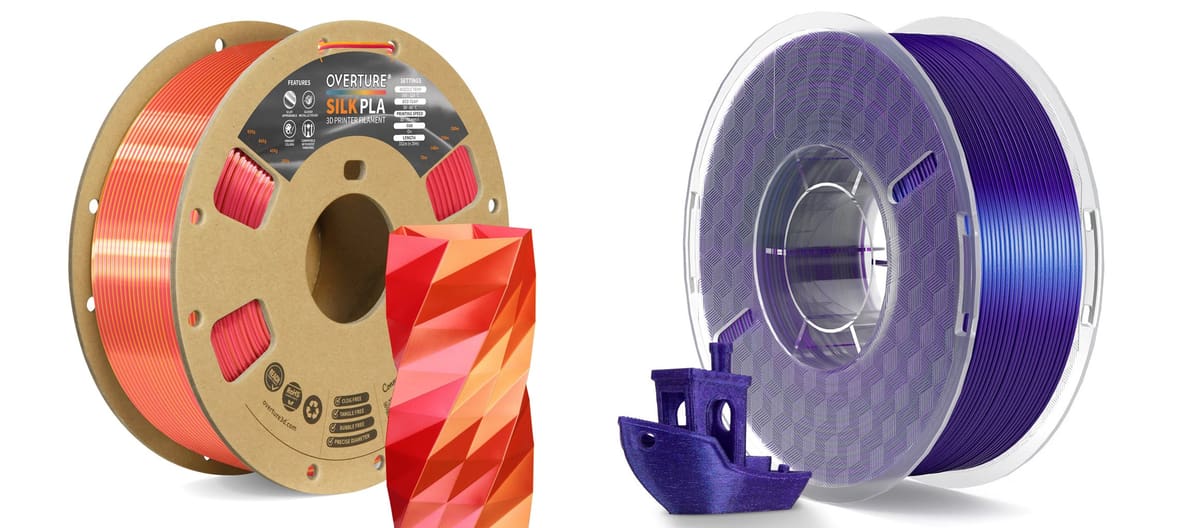
In the realm of consumer 3D printing, polylactic acid (PLA) is king. Although it’s often compared to ABS – arguably the next in line to the throne – PLA is easily the most popular type of 3D printer filament, and for good reason: it’s easy to print on almost any printer, it comes in a huge variety of colors and styles, and it’s typically the cheapest.
3D Printer Filament Properties: PLA
- Strength: Medium | Flexibility: Low | Durability: Medium
- Difficulty to use: Low
- Print temperature: 180 – 230 °C
- Print bed temperature: 20 – 70 °C (but not needed)
- Shrinkage/warping: Minimal
- Soluble: No
- Food safety: Refer to manufacturer guidelines and read “Is PLA Food Safe?”
Generally PLA is easy to print with because has a lower printing temperature than most other filaments and it doesn’t warp as easily, meaning a heated print bed isn’t required (although it definitely helps). Another benefit of using PLA is it is generally considered an odorless filament, but many have reported smelling sweet candy-like fumes depending on the type of PLA. Of course, all 3D printing should be done in a well-ventilated environment.
Another appealing aspect of PLA is its availability in a nearly endless abundance of colors and styles, so many that most hobby printers will never need to leave the realm of PLA.
Major PLA Types:
- Hiigh-speed PLA
- Carbon-fiber-filled PLA,
- Flexible PLA
- High-temperature PLA
- Lightweight / Foaming PLA
PLA is more environmentally friendly than many 3D printer filaments because it’s made from renewable plant-based resources, primarily corn starch (most common), sugarcane, cassava or other carbohydrate-rich crops. PLA is biodegradable only under industrial composting conditions (high heat, moisture, and microbial activity). In landfills or typical environments, it behaves like regular plastics.
When Should I Use PLA 3D Printer Filament?
In this case, a better question might be “when shouldn’t I use PLA?” Compared to other types of 3D printer filament, PLA can be brittle and breakable. This is the main reason users move on from PLA to the polymers below.
You should also avoid using PLA with items that need to withstand higher temperatures, like outdoor use in summertime, since PLA tends to deform around temperatures of 60 °C or higher. For all other applications, PLA makes for a good overall choice in 3D printer filament.
Common prints include models, low-wear toys, prototype parts, and containers.
ABS
What is ABS?
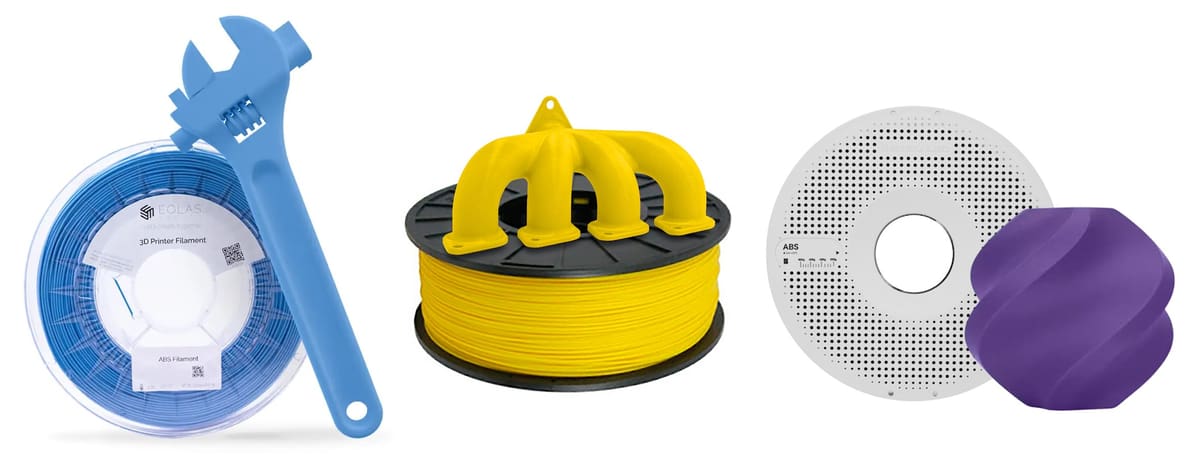
Acrylonitrile butadiene styrene (ABS) is less popular than PLA for everyday 3D printing, mainly because of its hazardous fumes. However, in terms of material properties, ABS is actually moderately superior to PLA, despite being more difficult to print – it’s prone to warping without a hot print bed and bed adhesive.
Commonly used in injection molding, ABS is found in many manufactured household and consumer goods, including LEGO bricks and bicycle helmets.
3D Printer Filament Properties: ABS
- Strength: High | Flexibility: Medium | Durability: High
- Difficulty to use: Medium
- Print temperature: 210 – 250 °C
- Print bed temperature: 80 – 110 °C
- Shrinkage/warping: Considerable
- Soluble: In esters, ketones, and acetone
- Food safety: Not food safe
Products made of ABS boast high durability and a capacity to withstand high temperatures, but 3D printer enthusiasts should be mindful of the filament’s high printing temperature, tendency to warp during cooling, and intense, potentially hazardous fumes. Be sure to print with a heated bed and a well-ventilated space (or with an enclosure).
3D Printer Filament Properties: ABS
- Strength: High | Flexibility: Medium | Durability: High
- Difficulty to use: Medium
- Print temperature: 210 – 250 °C
- Print bed temperature: 80 – 110 °C
- Shrinkage/warping: Considerable
- Soluble: In esters, ketones, and acetone
- Food safety: Not food safe
Products made of ABS boast high durability and a capacity to withstand high temperatures, but 3D printer enthusiasts should be mindful of the filament’s high printing temperature, tendency to warp during cooling, and intense, potentially hazardous fumes. Be sure to print with a heated bed and a well-ventilated space (or with an enclosure).
PETG
What is PETG?
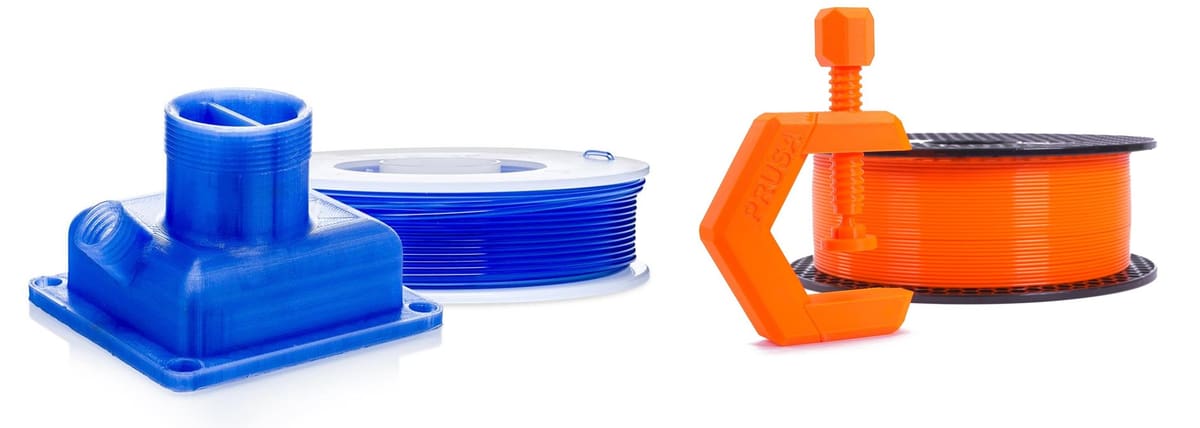
PETG (Polyethylene Terephthalate Glycol) is a widely used 3D printing filament known for its balance of strength, flexibility, and ease of use. It is a modified version of PET (the plastic used in water bottles), with glycol added to reduce brittleness and improve clarity and durability. PETG combines the best characteristics of PLA and ABS, making it a versatile material for a wide range of applications.
3D Printer Filament Properties: PETG
- Strength: High | Flexibility: Medium | Durability: High
- Difficulty to use: Low
- Print temperature: 220 – 250 °C
- Print bed temperature: 50 – 75 °C
- Shrinkage/warping: Minimal
- Soluble: No
- Food safety: Refer to manufacturer guidelines
PETG is semi-rigid, impact-resistant, and has good chemical and moisture resistance. It offers better durability and strength than PLA, while being easier to print than ABS. PETG is also less prone to warping, which means it generally doesn’t require an enclosed print chamber. It prints at moderate temperatures (typically 220°C-250°C), and adheres well to the print bed with minimal shrinkage. Additionally, it is food-safe (in some formulations), recyclable, and available in transparent or colored variants.
Three things 3D printer enthusiasts should keep in mind when using PETG:
- PETG is “hygroscopic”, meaning it absorbs moisture from the air. This has a negative effect on the printability of the material, so make sure to store the 3D printer filament in a cool, dry place and, if necessary, dry it before use.
- PETG is sticky when printed, making this 3D printer filament a poor choice for support structures but good for layer adhesion.
- Though not brittle, PETG scratches more easily than ABS.
When Should I Use PETG 3D Printer Filament?
PETG is a good all-rounder but stands out from many other types of 3D printer filament due to its flexibility, strength, and resistance to high temperature and impact. This makes it an ideal 3D printer filament to use for functional objects that might experience sustained or sudden stress, such as mechanical parts, printer parts, and protective components. Recycled PETG made from old water bottles and other sources is even better for the environment.
Three things 3D printer enthusiasts should keep in mind when using PETG:
- PETG is “hygroscopic”, meaning it absorbs moisture from the air. This has a negative effect on the printability of the material, so make sure to store the 3D printer filament in a cool, dry place and, if necessary, dry it before use.
- PETG is sticky when printed, making this 3D printer filament a poor choice for support structures but good for layer adhesion.
- Though not brittle, PETG scratches more easily than ABS.
When Should I Use PETG 3D Printer Filament?
PETG is a good all-rounder but stands out from many other types of 3D printer filament due to its flexibility, strength, and resistance to high temperature and impact. This makes it an ideal 3D printer filament to use for functional objects that might experience sustained or sudden stress, such as mechanical parts, printer parts, and protective components. Recycled PETG made from old water bottles and other sources is even better for the environment.


